Ecommerce integration is the deciding factor between brands that scale and brands that stall. You can have great products, strong demand, and strong marketing. But if your systems don't work together in real time, growth slows fast. Orders break. Inventory drifts. Teams fall back on spreadsheets.
Ecommerce integration solves this by connecting every system that powers your ecommerce business into one coordinated operational flow.
But more than half of ecommerce organizations report frustration with how hard it is to create and manage integrations across their systems. The issue is not effort. It is architecture.
Here's how growing brands can connect all their sales channels, their fulfillment options, and legacy systems at scale.
What is Ecommerce Integration?
Ecommerce integration is the process of connecting all the systems that run an ecommerce business so data moves automatically and accurately between them.
This includes sales channels, fulfillment partners, ERP systems, inventory platforms, financial tools, and shipping carriers. Instead of manually reconciling data across disconnected systems, ecommerce integration creates a single operational source of truth.
When integration is done well, orders flow cleanly, inventory stays accurate, and teams spend less time fixing problems and more time scaling the business.
Ecommerce integration is not just about moving data. It’s about running ecommerce as one connected system.
Here's what needs to connect in a typical ecommerce operation:
Sales and fulfillment channels including general marketplaces like Amazon and Walmart, specialty marketplaces like Wayfair, drop ship accounts and suppliers, 3PLs and channel fulfillment options like Amazon FBA and Walmart WFS, retail locations, regional distributors, and last-mile delivery services
Systems of record including your ERP, CRM, financial systems, and other legacy platforms that run core business functions.
Support systems including shipping carriers, product information management tools, warehouse management systems, and specialized software like fitment solutions.
Some of these systems have their own way of handling data. Others have different requirements for how basic information – even simple things like how SKUs are identified – gets formatted. Others use different methods to transfer data, sometimes including very old formats like emailing flat files. But they all need to work together in real time to keep your ecommerce business running smoothly.
Four Critical Challenges Every Ecommerce Integration Platform Must Solve
1. Integration Complexity and Scalability
Point-to-point integrations create tangled webs. Each new sales channel requires a custom connection. Each 3PL needs its own integration. Every system connects directly to every other system.
The point-to-point approach works when you have a few connections. It falls apart when you have many. Each connection is a potential failure point. When something breaks, IT teams scramble to figure out which connection failed and why. Then they (hopefully) fix it – until it breaks again.
The solution is a hub-and-spoke architecture. Instead of systems connecting directly to each other, they connect once to a central hub. The hub manages data transfer, normalization, aggregation, and monitoring among the connected systems.
When a new sales channel or fulfillment option is added, it connects to the hub. The hub already understands how to communicate with the rest of the ecommerce ecosystem.
2. Legacy System Compatibility
Legacy systems create a special ecommerce integration challenge. These are the ERPs, CRMs, and financial systems that companies have used for years. Other departments depend on them. They can't be shut down or replaced without disrupting the entire organization.
But these systems weren't designed for modern ecommerce.
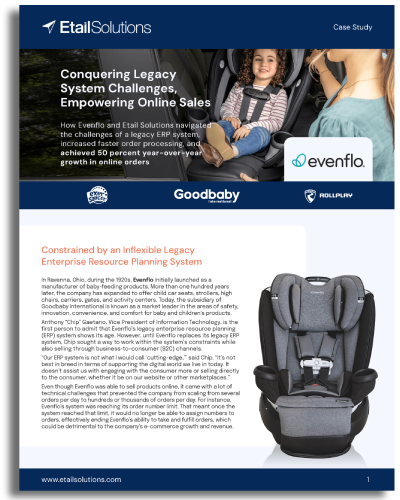
Here's an example. Anthony "Chip" Gaetano, VP of IT for Goodbaby International (which makes Evenflo baby products), faced a challenge. Company leadership wanted to vastly expand their direct-to-consumer fulfillment capabilities to meet aggressive growth plans. But their existing systems weren't built for it.
Evenflo's ERP worked well for shipping pallets to retail warehouses. It handled bulk orders with ease.
But Evenflo's legacy system used six-digit order numbers that worked perfectly for shipping cases on a pallet. Those same order numbers couldn't handle the volume of single-parcel-based consumer orders. Orders went from hundreds of orders per day to thousands per day. The old system maxed out.
They couldn't replace the ERP. It powered other critical parts of the business.
Evenflo implemented Etail as its ecommerce integration and operational platform. Etail became the operational layer above legacy systems, enabling modern order and inventory workflows without disrupting backend systems.
The result? Evenflo surged from processing a few hundred orders to over 10,000 orders per day with a 30% increase in order processing speed – all while maintaining their existing backend systems. For more details, check out our case study on how Evenflo managed integrating legacy systems to handle ecommerce.
A true ecommerce integration platform acts as a bridge. It allows legacy systems to participate in ecommerce operations without forcing a rip-and-replace project. Our Live Briefing with Evenflo's Chip Gaetano covers leveraging legacy systems to integrate and scale ecommerce operations.
For a deep dive on the ecommerce integration of legacy systems like BAAN, QAD, and others, read our blog post on Streamlining Ecommerce Integrations.
3. Real-Time Data Synchronization and Accuracy
Traditional ecommerce integration platforms connect endpoints and gather and transmit data. That's fine, as far as it goes. The problem is that it isn't enough just to transmit data – the data itself needs to be translated into a format that can be used for forecasting, analytics, and other data-driven decision making. Only then can the data be aggregated so you can see the big picture, not just what is happening at an individual node.
Different sales channels, suppliers, and other partners format their data differently. This is called data taxonomy.
Amazon categorizes products one way. Walmart uses a different system. Other sales channels have their own approach. Your 3PL might use yet another method. If you don't normalize and aggregate this data, you can't analyze it. You can't forecast demand. You can't make smart decisions about inventory and pricing.
An ecommerce operations platform also must recognize that different SKUs can represent the same core product – across private label programs, bundles, kits, and multipacks.
Etail solves this with a single item master SKU that consolidates partner taxonomies and merchandising options into one common view. Forecasting improves. Replenishment improves. Inventory yield and ROI improve.
4. IT Resource Strain and Support
IT teams are stretched thin. Creating, maintaining, and troubleshooting integrations consumes massive amounts of time and effort.
Everything works fine until it doesn't. Then an external system changes without warning. An API endpoint gets updated. A partner modifies its data requirements. Suddenly orders stop flowing. Or inventory doesn't sync. Or product listings disappear.
The IT team drops everything to find and fix the problem. This reactive firefighting leaves no time for strategic projects that could drive growth and innovation.
An ecommerce operations platform reduces this burden through automation, monitoring, and proactive alerts. It surfaces issues before they become business disruptions.
Support matters too. Managed implementation, training with real data, and ongoing operational support reduce internal strain and keep ecommerce running.
Learn more about the challenges of developing ecommerce integration capabilities in this blog post on IT Barriers to Growth.
Why Generic IPaaS Solutions Fall Short for Ecommerce
Many organizations depend on Integration Platforms as a Service (IPaaS) vendors as a system integration solution. And IPaaS has its place. Traditional IPaaS platforms promise centralized integration and workflow automation. Some of that is true. But ecommerce exposes its limits quickly.
Here's where generic IPaaS solutions fail ecommerce businesses:
Limited connectivity options: Most IPaaS vendors offer pre-built connectors for popular platforms like Amazon and Shopify. That sounds great until you need to connect to your specific 3PL's warehouse management system, your legacy ERP, or a niche sales channel. Then you're looking at a custom development project with additional costs and delays.
API dependence: IPaaS platforms work through APIs. But many retailers still use EDI and flat files. If your integration platform can't handle these older technologies, you can't work with important retail partners.
IPaaS can integrate disparate systems, but it can’t use connected data to run ecommerce operations.
Rudimentary tools: Some IPaaS vendors claim to offer order and inventory management. But these capabilities are basic. They don't handle order splitting, backorders, returns, distributed order routing, cartonization, rate shopping, or regional shipping templates. You end up integrating another third-party order management system, which means one more integration to manage and one more monthly bill.
Limited fulfillment options: Generic IPaaS systems usually support traditional warehouse fulfillment. Modern ecommerce shoppers demand more options including Buy Online Pickup In Store (BOPIS), drop shipping, and expedited shipping from multiple locations. Traditional IPaaS can't handle it.
Inadequate reporting: Ecommerce runs on data from multiple sources. Each source formats its data differently. IPaaS systems report on integration health, but to actually use this data for forecasting, troubleshooting, and decision-making, you might need another third-party reporting platform.
Scalability issues: Traditional IPaaS vendors often can't handle the data volume that ecommerce generates or support sudden sales spikes during holidays and events.
Fragmented support: IPaaS platforms push data from one system to another. When you have an order problem, a fulfillment issue, or a sales channel challenge, you need to contact the individual applications. Your IPaaS vendor probably can't help with actual ecommerce operations.
Hidden costs: Generic IPaaS solutions lack flexibility for ecommerce processes. You end up paying for additional connectors, custom development, and extra features. Plus, you might need separate order management, inventory management, and reporting systems. The costs add up quickly.
Get more detail on IPaaS platforms and ecommerce integrations in our blog post IPaaS For Ecommerce Integration: Why Traditional IPaaS Platforms Can t Handle Ecommerce.
What Sets Purpose-Built Ecommerce Integration Platforms Apart
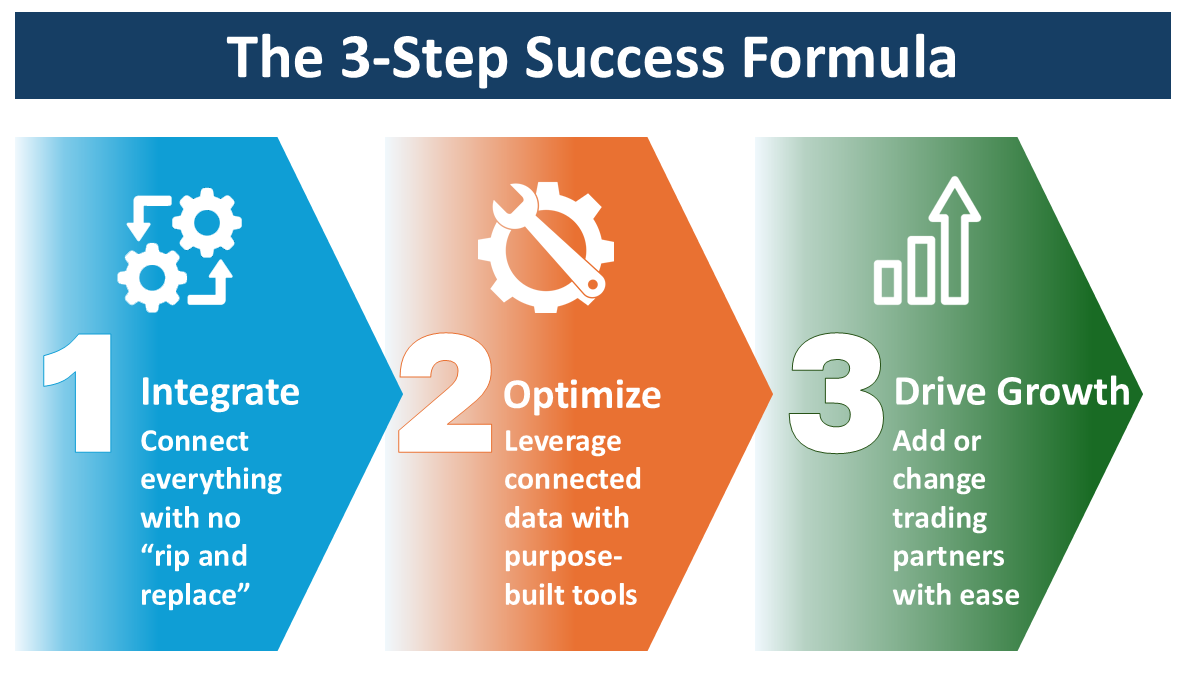
An ecommerce integration platform needs to do more than just connect systems. It needs to give your team the tools to drive the business forward using those systems.
Too often, companies choose an integration platform and then connect it to a separate order and inventory management system. Sure, the systems are technically integrated. But are they optimized to work together? Do they increase efficiency, cut costs, improve margins, and drive customer satisfaction?
A purpose-built ecommerce integration platform should include:
A powerful integration engine that uses hub-and-spoke architecture to connect all trading partners including sales channels, 3PLs, fulfillment locations, suppliers, legacy systems, and third-party tools.
Data normalization and aggregation that uses a single master SKU to combine all partner taxonomies into one common format for accurate analysis.
Comprehensive order management with distributed order routing that sends each order to the best, lowest-cost fulfillment option that meets customer expectations.
Multiple location inventory management including your warehouses, 3PLs, FBA and WFS, retail stores, regional distributors, and supplier locations with real-time visibility and forecasting.
Sales channel management that automatically updates product listings, pricing, and inventory availability based on actual fulfillment costs and inventory levels for each customer location.
Fulfillment optimization, including cartonization to select the best packaging, real-time carrier rate shopping, and support for modern fulfillment options like BOPIS and drop shipping.
Product information management to maintain consistent, accurate product data across all sales channels.
Analytics and reporting that aggregates data from all sources and presents it in formats you can actually use for decision-making.
All these capabilities need to work together as one integrated system. This level of integration and automation is what separates purpose-built ecommerce platforms from generic IPaaS solutions.
The Benefits of Getting Ecommerce Integration Right
When you implement a comprehensive ecommerce integration strategy with the right platform, several things happen:
Operational efficiency increases through automated processes, real-time data synchronization, and reduced manual work. This streamlines operations, improves productivity, reduces errors and returns, eliminates data silos, and saves money. Learn more about how ecommerce integration improves decision making in our blog post on eliminating Siloed Data and Spreadsheet Olympics.
Data accuracy and consistency improve when a centralized platform with strong data validation ensures data integrity across all systems. You can quickly spot exceptions for troubleshooting and make better decisions based on reliable information. Check out our Live Briefing with Dana Smith, VP of IT for Lasko Products, for insights on using integrated ecommerce data to drive growth.
Customer satisfaction and loyalty grow when you provide real-time visibility into order statuses and inventory levels. Customers get accurate information about their orders. They receive products on time. Their brand experience improves.
Scalability and adaptability expand because a flexible integration platform lets you easily add new sales channels, partners, and systems as your ecommerce operations grow. You're not locked into your current setup. You own the tech stack and you've future proofed your operations.
Your competitive edge sharpens because streamlined integrations help you respond quickly to market demands, add or change trading partners, handle acquisitions, and capitalize on emerging opportunities.
Research shows that 98% of ecommerce consumers say their fulfillment experience affects their loyalty toward a brand. Another study found that 85% of online shoppers say a poor fulfillment experience would prevent them from ordering from that retailer again.
Integration drives successful fulfillment, which drives brand loyalty. It's not just about connecting systems. It's about creating experiences that turn first-time buyers into repeat customers.
How to Choose the Right Ecommerce Integration Platform
When evaluating platforms, ask these questions:
For integration complexity:
- Can the platform centralize management of all integrations?
- Will it automate the manual transactions and data manipulation your team wastes time on today?
- Does it let you rapidly onboard new catalogs, suppliers, fulfillment locations, and sales channels?
- Does it offer flexible architecture that adapts as your business grows?
- Can it handle increased transaction volumes without performance problems?
- Does it simplify monitoring and provide real-time visibility into integration status?
- Does it automate security measures and ensure regulatory compliance?
For legacy system integration:
- Can the platform integrate seamlessly with your existing CRM and ERP?
- Can it handle data from older technologies like EDI and flat files?
- Will it minimize disruption to other systems during integration and ramp-up?
- If you plan to migrate to a more modern ERP eventually, can the platform assist with that transition?
For data integrity and consistency:
- Does the platform support real-time data synchronization across all systems?
- Does it ensure data accuracy and consistency across multiple systems?
- Are there strong data validation procedures?
- Can it spot data exceptions quickly for troubleshooting?
- Does it normalize and aggregate data for consistent analysis?
- Does it provide real-time insights and flexible reporting?
For reducing IT resource strain:
- Does the platform offer strong workflow automation?
- Does it monitor all feeds to help your IT team be proactive before issues cause major business impact?
- Does it provide professionally managed implementation?
- Does it include live training with your own data?
- Are comprehensive ramp-up and ongoing support services available?
- Can you outsource non-core IT activities like new employee onboarding or report creation?
- What is the platform's online reputation for responsiveness?
For operational efficiency and cost savings:
- Can the platform automate complex processes like distributed order routing and inventory tracking?
- Can it update order statuses, inventory levels, and customer information promptly?
- Does it provide interfaces for both IT users who manage integrations and business users who manage sales channels, inventory, and fulfillment?
- Are there tools for automatically identifying opportunities to streamline operations and improve productivity?
- Can it manage sales channel inventory availability and product listings automatically?
Ecommerce Integration: The Bottom Line
The winner in ecommerce isn't just the brand with the best products; it's also the brand with the most efficient operations.
By acting as an operational layer over legacy systems and embedding ecommerce logic directly into the platform, effective ecommerce integration becomes a growth engine instead of a constraint.
Ecommerce integration is where scalable, profitable ecommerce begins.
For a comprehensive playbook on managing ecommerce integrations, download our white paper on Mastering Ecommerce Integration: Bridging Legacy Systems & Cutting Edge Solutions.
Ecommerce Integration FAQs
What is ecommerce integration?
Ecommerce integration is the process of connecting ecommerce systems so data moves automatically between them. This includes sales channels, fulfillment partners, ERP systems, inventory platforms, and shipping tools. The goal is to keep orders, inventory, and customer data accurate and in sync without manual work.
Why is ecommerce integration important?
Ecommerce integration is important because disconnected systems slow growth and increase errors. Without integration, teams rely on spreadsheets and manual processes. Strong ecommerce integration improves efficiency, data accuracy, fulfillment speed, and the customer experience.
What systems are involved in ecommerce integration?
Ecommerce integration typically includes online marketplaces, direct-to-consumer websites, warehouses, 3PLs, ERP and other legacy systems, financial platforms, warehouse management systems, shipping carriers, and product information tools. All systems that touch orders or inventory should be integrated.
What is an ecommerce integration platform?
An ecommerce integration platform is software that connects and manages all ecommerce systems from a central hub. It supports APIs, EDI, and flat files, normalizes data, monitors integrations, and handles errors so ecommerce operations can scale reliably.
What is the difference between ecommerce integration and IPaaS?
The difference between ecommerce integration platforms and IPaaS tools is focus. IPaaS tools move data between systems. Ecommerce integration platforms are built for ecommerce workflows and support high order volume, legacy systems, inventory synchronization, and fulfillment logic.
Can ecommerce integration work with legacy ERP systems?
Yes, advanced ecommerce integration platforms like the one powering Etail can work with legacy ERP systems. A purpose-built integration platform acts as a bridge, allowing ecommerce channels to operate at scale without replacing core backend systems.
How long does ecommerce integration take?
Ecommerce integration timelines depend on system complexity and partner requirements. Purpose-built ecommerce integration platforms reduce setup time by using standardized data models, reusable connectors, and managed onboarding.
What should you look for in an ecommerce integration solution?
When choosing an ecommerce integration solution, look for centralized integration management, support for multiple data formats, real-time data synchronization, strong monitoring, and ecommerce-specific operational capabilities. The best solutions help run ecommerce operations, not just connect systems.
Additional Resources for Ecommerce Integration
PLATFORM OVERVIEWS
BLOG POSTS
IPaaS for Ecommerce Integration: Why Traditional IPaaS Platforms Can't Handle Ecommerce
Siloed Data and Spreadsheet Olympics: Taming Data Silos and Dis-Integrated Systems
Streamlining Ecommerce Integrations: Integrating Legacy Systems with Modern Solutions
CASE STUDIES
Evenflo: Navigating the Challenges of a Legacy ERP System
WHITE PAPERS
Mastering Ecommerce Integration: Bridging Legacy Systems & Cutting Edge Solutions
LIVE BRIEFINGS