Ecommerce fulfillment is the difference between a brand that scales smoothly and a brand that spends its time, budget, and people chasing problems. You can add warehouse space, hire more people, and negotiate carrier rates. But if fulfillment decisions are slow, manual, or disconnected, growth turns into higher costs, more exceptions, and broken delivery promises.
Modern ecommerce fulfillment works differently. It turns fulfillment into one coordinated system where inventory, orders, locations, packaging, and shipping decisions work together in real time.
At a small scale, fulfillment runs on people and process. At full scale, it runs on systems and decision logic. This guide explains ecommerce fulfillment through that lens: what it is, why it breaks, and how leading operators design it to scale.
For a complete playbook on scaling ecommerce fulfillment, check out our white paper on Seven Steps to Scale D2C Fulfillment.
What is Ecommerce Fulfillment?
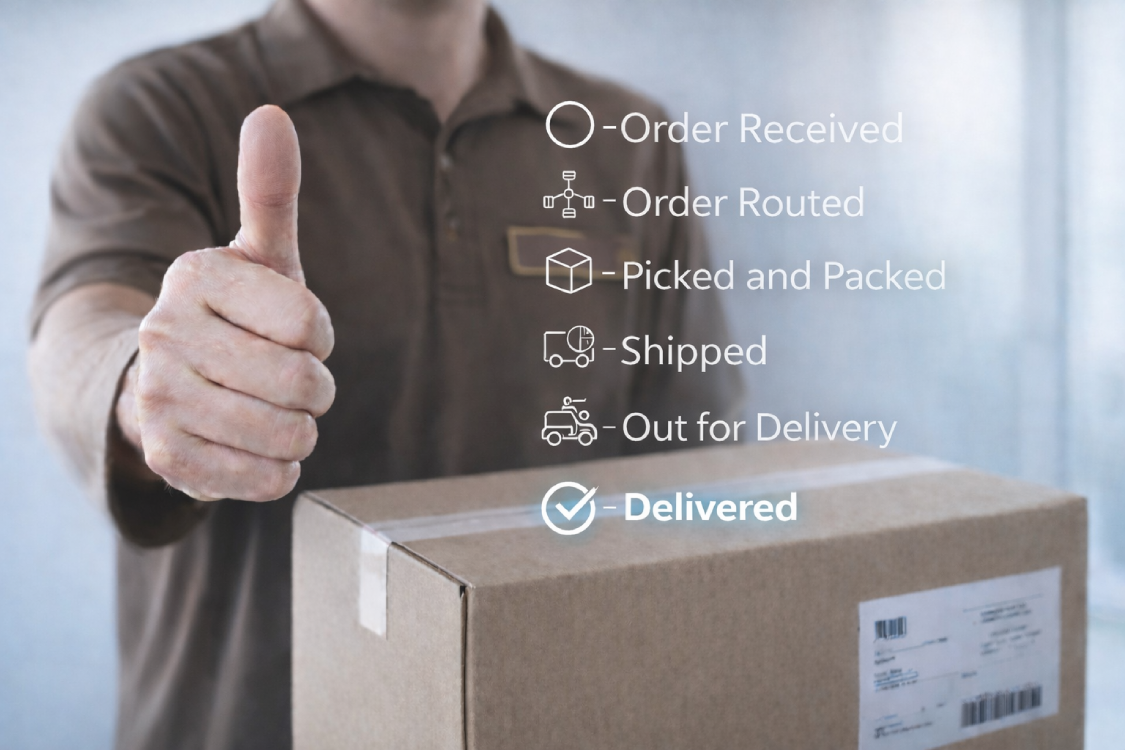
Ecommerce fulfillment is the set of processes and decisions that move an order from placed to delivered. It includes order routing, picking and packing, packaging choices, shipping, and customer and channel communication. It also includes the rules that determine how each of those steps happens for every order.
Ecommerce fulfillment is not just warehouse execution. It is the design and decision system that controls cost, speed, reliability, and customer experience across the entire operation.
How Ecommerce Fulfillment Actually Works
Ecommerce fulfillment looks simple from the outside. An order is placed. A box shows up on the customer's doorstep. In reality, fulfillment is one of the most operationally complex parts of running an ecommerce business. Every order triggers a chain of decisions that must stay aligned across sales channels, inventory, systems, people, and partners.
Every order triggers a chain of decisions, not just a pick ticket.
While fulfillment workflows vary by business, most ecommerce fulfillment operations follow a similar sequence.
Warehouse Storage
Products ready for sale must be stored somewhere, whether that's a brand-owned warehouse or distribution center, a 3PL, a marketplace partner, or a distributor. Storage decisions influence picking efficiency, labor cost, and how quickly orders can ship. As fulfillment volume grows, warehouse location and stocking become a strategic decision, not just a space problem. Storing inventory at multiple locations can cut delivery time and expense, but also ties up working capital while increasing inventory and order management complexity.
Inventory Management
Inventory management determines what can be sold, where it can ship from, and how confidently delivery promises can be made to customers and sales channels. If inventory data is wrong, everything downstream breaks. Things get complicated when multiple warehouse locations – or fulfillment partners like 3PLs or Amazon FBA – get involved.
Order Intake and Routing
When an order is placed, the real work begins. The system must decide where the order should ship from, whether it needs to be split, which service level applies, and which constraints matter most. Distributed order management – routing the order to the fulfillment location with the lowest delivered cost – is critical to ecommerce profitability.
Picking and Packaging
Once an order is received by the fulfillment location, items are picked, packed, and prepared for shipment. Packaging choices matter here. The wrong carton increases cost and damage risk. The right one protects margins and customer experience.
Shipping and Delivery
Shipping moves the order from the warehouse to the customer. It includes carrier selection, service level choice, labeling, and communicating tracking information to customers and sales channels. Customers expect realistic delivery promises and consistent execution. Sales channels demand that products be delivered on time – or sellers could face stiff penalties like delisting. Missed delivery expectations are one of the fastest ways to lose consumer trust...and sales channel partners.
Returns and Reverse Logistics
Returns are not an edge case. They are a core part of ecommerce fulfillment. Processing returns efficiently affects cost, sustainability, inventory availability, and customer loyalty.
What makes ecommerce fulfillment difficult is not any single step. It's that all these steps must work together, every time, in real time, under changing conditions. That's why fulfillment stops scaling when it's managed as a static checklist and starts scaling when it's designed as a flexible system.
For a playbook on designing ecommerce fulfillment systems, check out our blog post on Ecommerce Fulfillment: Meeting the 1-2 Day Delivery Challenge.
Why Ecommerce Fulfillment Matters
Ecommerce fulfillment is one of the few parts of the business that affects brand perception and profit at the same time. When it works, customers barely notice. When it fails, customers remember. And for some products, fulfillment costs can total to 70 percent of the product's total delivered cost. So any impact on fulfillment cost – good or bad – has a major impact on the bottom line.
Fulfillment decisions are brand decisions and margin decisions.
Every fulfillment decision shows up somewhere. Delivery speed. Shipping cost. Packaging quality. Order accuracy. Returns experience. Over time, these moments determine whether customers trust the brand enough to reorder.
Fulfillment is not just operational follow-through; it's a brand promise made real. Fast, reliable delivery reinforces trust. Inconsistent fulfillment erodes it, even when the product itself is strong. Consumers remember a poor fulfillment experience – it's one of the final touchpoints with the brand when ordering a product online. If the experience goes sour, consumers take it out on the brand. Explore more in our post on how ecommerce fulfillment builds brand loyalty.
98% of ecommerce consumers say that their delivery experience affects their loyalty towards a brand. 84% of consumers will not shop from a brand again after just one poor delivery experience.
Shipping is where this impact is most visible. Customers may forgive a confusing product description, but they rarely forgive late or expensive delivery. Shipping speed, accuracy, and cost are often the final interaction with a brand before a customer decides whether to shop with them again. To learn more, check out our analysis of how shipping drives customer satisfaction with fulfillment.
From a margin perspective, ecommerce fulfillment is just as powerful. Shipping, labor, packaging, and returns make up a large share of total delivered cost. Small inefficiencies compound quickly at scale. Split shipments increase carrier spend. Poor inventory positioning drives expedited shipping expenses. Bad packaging inflates dimensional weight and damage rates. Returns amplify all of it.
This is why high-performing ecommerce organizations treat fulfillment as a strategic system, not a back-office function. When fulfillment is designed intentionally, it protects both. When it isn't, growth exposes the cracks.
Ecommerce Fulfillment Options: Choosing The Right Model as You Scale
There is no single right way to fulfill ecommerce orders. The right option depends on volume, product mix, margins, service level expectations, and how much control the business needs. Most brands use more than one fulfillment model to get the job done. Each one solves a specific problem and introduces a different set of tradeoffs.
Do-It-Yourself Fulfillment (In-House)
In-house ecommerce fulfillment offers maximum control. You own the warehouse, labor, processes, and systems. This model works well early as the brand is building its ecommerce fulfillment capabilities or for products with specialized handling needs.
As order volume grows, strain often appears. Hiring and training never stop. Space runs out. Peak seasons expose capacity limits. At scale, in-house fulfillment only works when decision-making is standardized and systems – not people – do most of the work.
Marketplace Fulfillment (Amazon FBA, Walmart WFS, and Others)
Marketplace fulfillment trades control for reach and speed. Programs like Amazon FBA and Walmart WFS provide built-in logistics, fast delivery, and customer trust within the marketplace.
The tradeoff is flexibility. Marketplace fulfillment works best for high volume, smaller-sized products. Fees can be high. Rules and requirements change often – sometimes with little notice. Service decisions are controlled by the marketplace, not the brand. Marketplace fulfillment works often best as a channel strategy, not a complete ecommerce fulfillment strategy.
Third-Party Logistics Providers (3PLs)
3PLs provide fast access to space, labor, and geography without capital investment. They are often the quickest way to support growth or seasonal spikes. They can also specialize in products that have unique handling requirements, such as cold storage and shipping.
The challenge is coordination. Each 3PL introduces new systems, processes, and service variability. Without strong management, 3PL networks increase exceptions and inconsistency. For a guide on using 3PLs for ecommerce fulfillment, check out our blog post on Expanding D2C Fulfillment Without Losing Control.
Regional Distributors and Wholesalers
Some brands fulfill ecommerce orders through regional distributors or wholesale partners. This can shorten delivery distance and leverage existing inventory.
The downside is limited visibility and control. Inventory accuracy, service levels, and branding vary by partner. This model works best when distributors are tightly integrated and ecommerce demand is predictable.
Dropship And Supplier-Direct Fulfillment
Dropship fulfillment expands assortment without holding inventory. It works well for long-tail SKUs or product testing.
At scale, drop shipping introduces risk. Lead times vary. Inventory data is often unreliable. Customer experience depends on partners who may not prioritize ecommerce orders. Dropship models require clear rules about when and how they are used.
Hybrid Fulfillment is the Real-World Default
Most scaled ecommerce operations use a hybrid model. Core SKUs may ship in-house. Overflow goes to 3PLs. Marketplace orders route through FBA or WFS. Select products are drop shipped.
Hybrid ecommerce fulfillment only works when decision logic is centralized. Without that, each fulfillment option becomes a silo, and cost and service quickly drift out of control. The real question is not which option is best, but whether the business can coordinate all of them as one system.
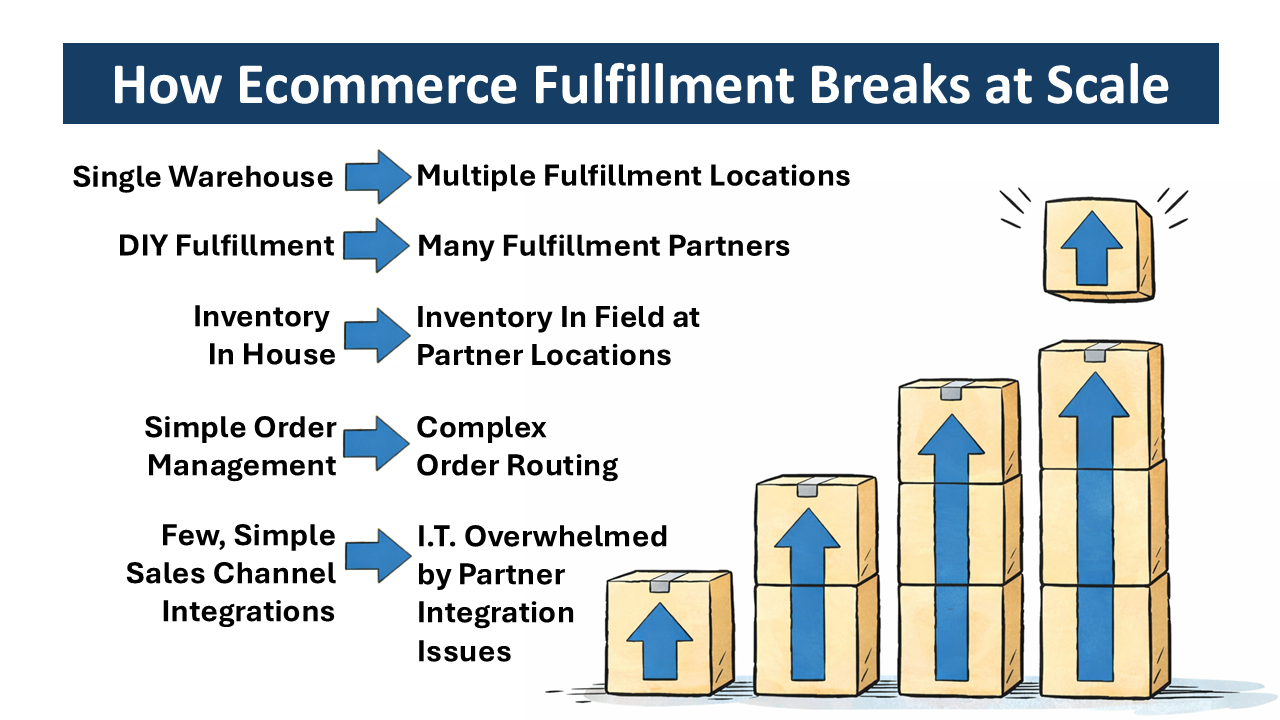
Five Fulfillment Building Blocks That Decide Whether You Can Scale
Most ecommerce fulfillment failures are not execution problems. They are design problems. Teams optimize individual functions, but the system underneath them was never built to handle growth, complexity, or change.
Fulfillment only scales when these building blocks work together.
These five building blocks determine whether ecommerce fulfillment scales cleanly or collapses under pressure. Each one influences cost, service, and flexibility. More importantly, they all interact. When designed in isolation, problems compound. When designed together, fulfillment becomes predictable and resilient.
1. Network and location strategy
Where you fulfill from sets the ceiling for delivery speed and the floor for shipping cost. It also determines how often orders are split, how hard inventory is to balance, and how many exceptions teams manage daily.
As networks expand, complexity often grows faster than volume. Adding locations without a clear strategy creates routing confusion and inventory silos. Brands that scale well design networks intentionally and simplify decisions as nodes are added. Check out this blog post to learn more about managing multi-location ecommerce fulfillment.
2. Inventory visibility and availability
Inventory only creates value if it can be trusted and used. As channels, locations, and partners multiply, inventory accuracy becomes harder to maintain and easier to overpromise.
Poor visibility drives excess safety stock, expedited shipments, and cancellations. Strong ecommerce fulfillment systems treat inventory as a shared, real-time resource and align availability rules with service goals.
3. Execution inside the warehouse
Warehouse execution still matters. Labor planning, pick paths, slotting, and quality checks affect throughput and accuracy. But at scale, warehouses are downstream of decisions made elsewhere.
When routing logic is inconsistent or inventory data is unreliable, warehouse teams absorb the pain. High-performing organizations fix the system first so execution becomes predictable instead of reactive.
4. Packaging decisions and cartonization
Packaging is one of the most overlooked ecommerce fulfillment decisions. It directly affects shipping cost, damage rates, sustainability, and customer perception.
Oversized cartons inflate dimensional weight. Poor packaging increases returns and reships. Cartonization brings discipline by matching each order to the right box automatically. Click here to learn more about cartonization and how cartonization can help cut ecommerce fulfillment costs.
5. Shipping strategy and carrier decisions
Shipping is often the largest variable cost in ecommerce fulfillment, yet many teams treat it as a last-step task.
Winning teams define shipping rules upfront, balance cost and speed intentionally, and adjust dynamically. Since shipping often accounts for the highest expense in fulfilling an ecommerce order, optimizing it quickly boosts the bottom line. For tips, check out our post on optimizing ecommerce shipping.
Together, these building blocks determine whether ecommerce fulfillment supports growth or becomes a constant source of friction.
Cutting Ecommerce Fulfillment Costs Without Breaking the Business
Cost pressure in ecommerce fulfillment never lets up. Shipping rates rise. Labor tightens. Customers expect faster delivery for less money. When margins are stressed, teams are told to cut costs – often without changing the system that created them.
The common response is blunt force. Labor is reduced. Service levels are lowered. Inventory is centralized. These moves cut cost short term and create bigger costs later through exceptions, split shipments, expedites, and churn.
Most fulfillment costs are decision costs. They come from where inventory sits, how orders are routed, how packaging is chosen, and how shipping methods are selected. When decisions are inconsistent or manual, cost leaks out everywhere.
High-performing teams focus on eliminating avoidable work. They reduce split shipments through better inventory positioning. They lower shipping costs by routing smarter, not shipping slower. They cut labor cost by making execution predictable.
Our post on cutting ecommerce fulfillment costs outlines tactics that address root causes instead of symptoms.
Sustainable Ecommerce Fulfillment
Sustainability in ecommerce fulfillment is driven by daily operational decisions, not marketing claims. Packaging choices, delivery distance, carrier selection, and return flows all shape environmental impact.
At scale, small inefficiencies multiply. Oversized cartons waste material and fuel. Poor inventory placement increases shipping distance. High return rates double the footprint of every order.
Leading teams manage sustainability the same way they manage cost and service. They measure it, track it, and build it into decision logic. Many sustainability improvements also reduce cost: smaller cartons, shorter delivery distances, and fewer returns.
Our post on sustainable ecommerce fulfillment shows how operational excellence and sustainability are increasingly aligned.
Decision-Making: Where Ecommerce Fulfillment Succeeds or Fails
All fulfillment building blocks depend on how decisions are made.
As networks grow, decisions multiply. Where should this order ship from? Should it be split? Which carton should be used? What service level makes sense right now? Manual judgment and disconnected systems slow decisions and create inconsistency.
High-performing ecommerce organizations separate decision-making from execution. They centralize logic and allow execution to scale across locations and partners. Rules define priorities. Constraints are enforced automatically. Exceptions are handled intentionally.
Fulfillment scales because decisions become repeatable. For a guide on how to scale ecommerce operations, check out our tips for scaling D2C fulfillment.
How To Create an Ecommerce Fulfillment Strategy That Scales
A scalable ecommerce fulfillment strategy starts with clarity, not technology. You need to understand where you are today, where the business is going, and which decisions must remain consistent as everything changes.
Start by mapping reality, not aspiration. Where inventory actually lives. How orders are routed in practice. Which decisions are automated and which rely on people.
Next, define non-negotiables. When do you favor speed over cost? When is splitting acceptable? Which customers get priority when inventory is tight?
Then design fulfillment around decisions, not locations. Networks change. Volumes spike. Decision logic should hold.
Plan for change, not steady state. Peaks, new channels, and disruptions are inevitable. Strong systems adapt without constant rework.
Finally, measure signals that show the system is breaking. Rising splits, overrides, expedites, and returns are early warnings, not execution failures.
A scalable ecommerce fulfillment strategy is a framework for better decisions as the business grows. Learn more in our guide to data-driven ecommerce fulfillment.
Ecommerce fulfillment is a connected system of decisions. As you scale, that system either holds or it breaks.
Brands that scale ecommerce fulfillment smoothly treat fulfillment as a design problem first. They connect network strategy, inventory, packaging, shipping, cost control, and sustainability through shared decision logic instead of silos.
When ecommerce fulfillment is designed as a system, execution becomes predictable. Costs stabilize. Customer experience improves. Teams spend less time firefighting and more time improving performance.
Ecommerce fulfillment doesn't just support growth. It determines how far and how fast a business can scale.
Ecommerce Fulfillment FAQs
Below are answers to the most common questions operations teams ask about ecommerce fulfillment.
What is ecommerce fulfillment?
Ecommerce fulfillment is the process and decision system that moves an online order from purchase to delivery. It includes inventory availability, order routing, picking and packing, packaging, shipping, and returns. At scale, ecommerce fulfillment also includes the rules and systems that decide how each step happens for every order.
How does ecommerce fulfillment work?
Ecommerce fulfillment works through a sequence of connected steps: inventory is stored, orders are received, fulfillment locations are selected, items are picked and packed, shipments are delivered, and returns are processed. The complexity comes from coordinating these steps across multiple locations, channels, and service levels while controlling cost and customer experience.
What are the main ecommerce fulfillment options?
The main ecommerce fulfillment options include in-house fulfillment, third-party logistics providers (3PLs), marketplace fulfillment programs like Amazon FBA or Walmart WFS, regional distributors, dropship or supplier-direct fulfillment, and hybrid models that combine multiple approaches. Most growing brands use more than one option at the same time.
What is the difference between ecommerce fulfillment and shipping?
Ecommerce fulfillment includes everything required to deliver an order, while shipping is only one step in the process. Fulfillment covers inventory management, order routing, picking and packing, packaging, carrier selection, delivery promises, and returns. Shipping focuses specifically on transporting the order to the customer.
What is a scalable ecommerce fulfillment strategy?
A scalable ecommerce fulfillment strategy defines how fulfillment decisions are made as order volume, locations, and channels grow. It prioritizes centralized decision logic, flexible execution, and systems that adapt without constant rework, so cost, service, and reliability stay consistent as the business scales.
Why does ecommerce fulfillment get harder as a business grows?
Ecommerce fulfillment becomes harder as a business grows because volume, locations, channels, and exceptions increase. Manual decisions and disconnected systems stop working, leading to higher costs, inconsistent service, and more operational workarounds. Growth exposes weaknesses in fulfillment design.
What causes high ecommerce fulfillment costs?
High ecommerce fulfillment costs are usually caused by poor inventory positioning, split shipments, inefficient packaging, inconsistent order routing, expedited shipping, and high return rates. These costs often come from fulfillment system design, not warehouse execution alone.
How can ecommerce businesses reduce fulfillment costs without hurting service?
Ecommerce businesses can reduce fulfillment costs by improving inventory placement, reducing split shipments, optimizing packaging, and routing orders more intelligently. Focusing on better decisions – rather than cutting labor or slowing shipping – lowers cost while protecting customer experience.
Additional Resources for Ecommerce Fulfillment
BLOG POSTS
Cutting Ecommerce Fulfillment Costs
D2C Fulfillment: Tips for Scaling and Thriving in a Decade of Disruption
Data-Driven Ecommerce Fulfillment
Direct To Consumer: Should Your Brand Make the Move?
Ecommerce Fulfillment: Meeting the 1-2 Day Delivery Challenge
The Ecommerce Fulfillment Advantage: Eight Strategies to Build Loyalty with Ecommerce Fulfillment
Expanding D2C Fulfillment without Losing Control
Shipping Drives Customer Satisfaction
Simplify Multi-Location Ecommerce Fulfillment
Sustainable Ecommerce Fulfillment
What is Cartonization? Automate Selecting the Best Packaging Option Every Time
WHITE PAPERS
Seven Steps to Scale D2C Fulfillment
Ecommerce Fulfillment: Meeting the 1-2 Day Delivery Challenge
INFOGRAPHICS
LIVE BRIEFINGS
How Successful D2C Brands Expand Fulfillment Without Losing Control