Distributed order management (DOM) isn’t new. But how the fastest-growing ecommerce brands are using DOM is.
Once exclusive only to high-end, large enterprise systems, companies like Etail Solutions pioneered making distributed order management affordable for mid-size brands and sellers.
So DOM has now become the backbone of scalable, high-performance ecommerce operations – especially for brands looking to expand their direct-to-consumer (D2C) fulfillment.
In this guide, we’ll break down what distributed order management is; how DOM works; and how to use it to move faster, cut costs, and boost customer satisfaction.
Distributed Order Management Defined: Distributed order management (DOM) is a rules-based system that tracks inventory and automates how ecommerce orders are routed across multiple fulfillment locations – warehouses, 3PLs, stores, or suppliers. DOM increases efficiency, lowers costs, and improves delivery accuracy by selecting the best fulfillment option for every order.
What Is Distributed Order Management?
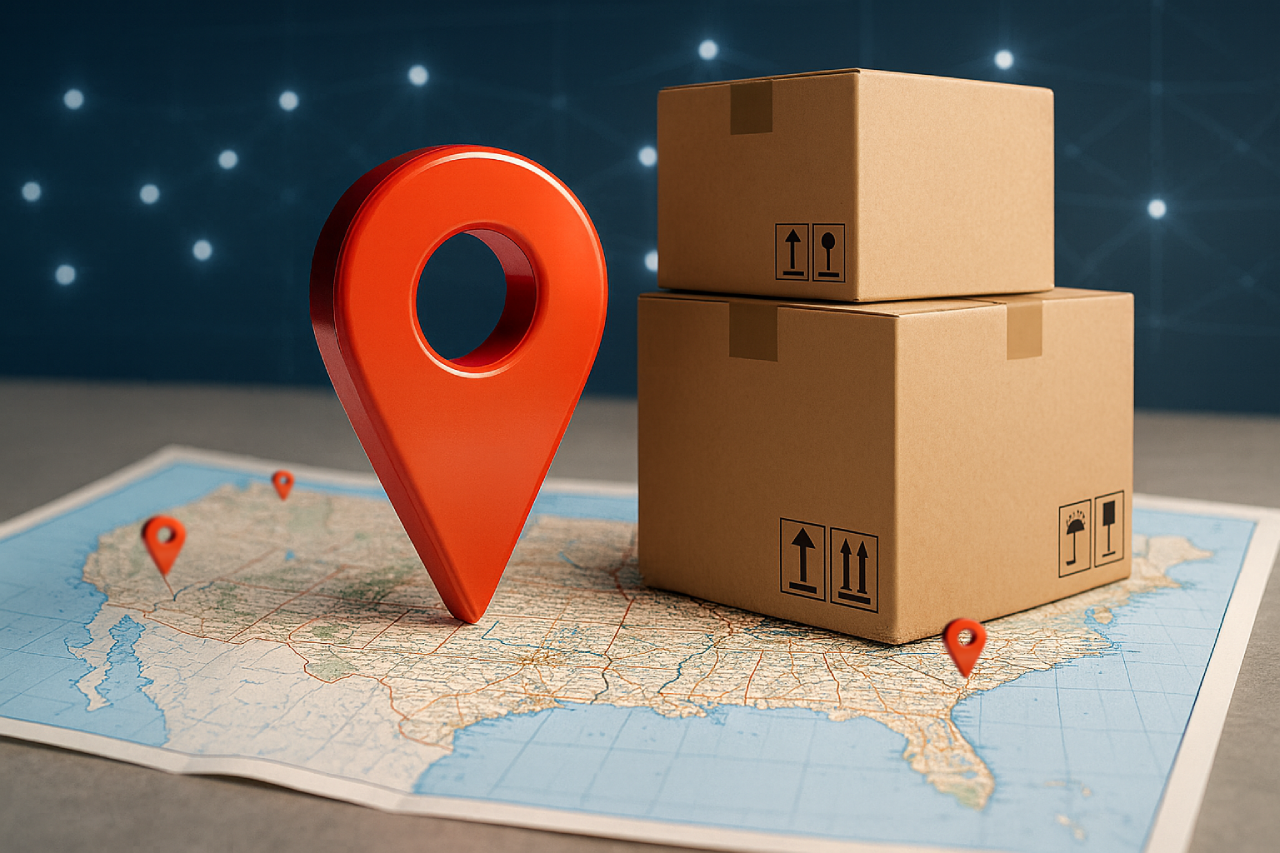
Distributed order management is a rules-based system that tracks inventory and routes orders for fulfillment across multiple nodes – warehouses, 3PLs, retail stores, regional distributors, suppliers, or any other fulfillment option.
DOM intelligently decides:
- Where to fulfill from based on inventory, location, cost, and timing
- How to split or consolidate orders when needed
- How to apply channel- or customer-specific rules
DOM unlocks real margin optimization by selecting the most cost-effective fulfillment option for every order. That maximizes profit per order.
DOM does more than route orders. It makes every order decision a margin opportunity. It’s designed for multichannel, multi-node fulfillment environments where speed, cost control, and flexibility matter.
For a more detailed breakdown, explore our post on the basics of distributed order management strategy: Distributed Order Management: What It Is, Why It’s Necessary, How to Get Started.

How DOM Optimizes Ecommerce Fulfillment
Amazon has trained ecommerce shoppers to expect fast, low or no-cost fulfillment of their online purchases. Other customers expect to pick up their online orders curbside or in retail stores. Speed, accuracy, and delivery flexibility are now core to the customer experience.
And for many brands, order fulfillment is a huge component of product cost – and getting more expensive every day.
By placing inventory at multiple locations – closer to potential customers – sellers can cut delivery distance, time, and expense. With DOM, you can:
- Fulfill from anywhere you have inventory
- Get real-time inventory visibility across all options
- Automate order routing to the best based on your business rules – with an emphasis on reducing total delivered cost
- Meet sales channel and customer delivery time expectations while realizing the most margin possible off every order.
For a deeper dive, explore our blog post on how to Optimize Fulfillment with Distributed Order Management.
Competitive Advantages of Distributed Order Management
Cutting fulfillment time and cost while boosting margins aren’t the only advantages of implementing distributed order management. DOM is a powerful lever for cost reduction and fulfillment efficiency. But the full list of benefits goes deeper:
Improved Sustainability
DOM is designed to cut delivery expense – usually by selecting the stocking location closest to the customer. That not only reduces delivery distance, but the shorter distance also reduces the order’s carbon footprint.
In fact, a study of one Etail customer showed a 35% reduction in carbon footprint – and $5.7 million in delivery cost savings – by implementing DOM. Check out this blog post for more information on DOM and ecommerce sustainability – including a method for measuring your ecommerce carbon footprint.
Increased Customer Satisfaction
Research shows that the delivery experience is a major driver of customer satisfaction and brand loyalty.
In fact:
- 90% of online shoppers say that their shipping delivery experience accounts for at least half of their total online shopping experience.
- 98% of ecommerce consumers say their delivery experience affects their loyalty towards a brand.
- 82% of online shoppers who are satisfied with their delivery experience will share and recommend the brand to friends and family.
- 72% of customers satisfied with their delivery experience will increase their purchase levels with the brand by 12%.
But get delivery wrong and the results won’t be pretty.
- 85% of online shoppers say that a poor delivery experience would prevent them from ordering from that online retailer again.
A well-implemented DOM system provides:
- Faster Order Processing: DOM's ability to route orders to the most suitable location results in quicker order processing and reduced delivery times.
- Real-time Inventory Tracking: Employing technology to provide real-time visibility into inventory across all channels helps businesses avoid stockouts and overselling. Preventing customers from placing orders for out-of-stock items builds trust and avoids negative experiences.
- Automated Error Reduction: Automation reduces human errors and expedites order processing. Mistakes in shipping the wrong item or missing items can lead to customer frustration and disappointment.
- Better Customer Communications: Effective order management includes clear and timely communication with customers. DOM automation drives better communication with customers regarding order status, shipping updates, and delivery times. Customers appreciate being kept informed, which leads to higher satisfaction.
For more details on using DOM to increase ecommerce customer satisfaction, check out our post on Maximizing Customer Satisfaction with Distributed Order Management.
Strategic Advantages You Might Miss
We've seen how distributed order management software offers a powerful tool to boost margins and improve your customer experience.
The advantages of DOM are clear: reduce fulfillment cost and improve margins by routing each order to the best fulfillment option. But several advantages of implementing a DOM solution are not so obvious:
Gain Full Visibility Across Your Operation
DOM unifies data from order, inventory, and fulfillment systems to give you complete visibility. That helps improve forecasting, reduce excess stock, and position inventory where it’s needed most.
Improve Inventory Yield and ROI
Distributed Order Management improves inventory yield by intelligently routing orders to fulfill from the most efficient location – reducing dead stock and over-allocation. By syncing real-time demand with inventory availability across all nodes, DOM increases inventory turnover and drives higher return on every inventory dollar.
Add Advanced Capabilities Without Replacing Existing Systems
Extend your current tech stack without starting from scratch. DOM layers on top to automate fulfillment logic, cut costs, and accelerate deployment.
Stay in Control as You Scale
Easily add or switch fulfillment providers – like 3PLs or warehouses – without disrupting operations. You maintain full control over your fulfillment architecture.
Free Up I.T. Resources
Avoid complex custom integrations and reduce system maintenance demands. DOM is built to work with minimal IT support, freeing teams to focus on innovation.
Make Data-Driven Decisions
Access real-time insights into fulfillment performance and cost. Connect DOM data with analytics tools to drive smarter decisions across teams.
Future Proof Your Business
As ecommerce evolves, DOM lets you adapt quickly. It’s designed to integrate with new channels, partners, and fulfillment models without major disruption.
When you implement DOM well, you unlock more than just faster fulfillment or lower shipping rates. Click here to learn more about some of the less obvious but powerful advantages of distributed order management systems.
Choosing the Best Distributed Order Management Platform
To unlock the full potential of DOM, you need more than basic routing logic. A strong DOM platform acts as an intelligent control tower – balancing inventory, cost, sales channel service level agreements (SLAs), and customer experience.
To work well, a DOM platform should offer:
Advanced Integration Capabilities
The real power of DOM lies in its ability to unify your systems and partners. From legacy ERPs to modern APIs, DOM must sit at the center of your fulfillment tech stack – connecting channels, 3PLs, WMS, and suppliers into a single, responsive network.
Many DOM systems only operate within their ecosystem – every fulfillment node must be running that vendor’s software. More advanced systems, like Etail’s, are system agnostic. They work with whatever OMS, IMS, or WMS is already in place.
Integration capabilities are the backbone of a powerful, scalable distributed order management system. DOM only works when everything talks to everything.
It’s important to remember that while your ecommerce operations may be running on cutting-edge software, the rest of your organization depends on legacy ERP and other systems that can’t easily be replaced.
DOM can’t function in a silo. Its real value comes from how well it connects to your ecommerce tech stack, legacy systems, sales channels, and fulfillment partners.
Inventory Aggregation
Unified view of available-to-sell inventory across every location and in any merchandising bundle or configuration. This drives better inventory ROI by reducing overstock and helping you position inventory closer to demand.
Order Orchestration
Automated routing based on your logic – by cost, speed, margin, customer tier, geography, etc. This logic allows for real-time profit maximization on each order – not just cost reduction. Also, advanced DOM systems like Etail support multiple formats for orders – flat file, API or EDI – to ensure you can integrate with any sales channel or vendor.
Rule Engine Flexibility
Business rules engine that adapts to promotions, restrictions, blackout dates, and channel-specific SLAs. And because these rules are configurable, they evolve with your fulfillment network – future-proofing your strategy.
Order Splitting
Supports multi-node, multi-vendor fulfillment on a single order, which lets you provide more flexible shipping options and increase basket conversion.
Real-Time Data Updates
Real-time (not batched) data sync between systems: ERP, WMS, marketplaces, storefronts, and 3PLs. This enables better reporting, tighter forecasting, and shared visibility across your organization.
This blog post provides a detailed overview of how to choose the best distributed order management system for your organization.
Distributed Order Management Best Practices
Success with DOM doesn’t happen by accident. It requires deliberate planning, data accuracy, and ongoing optimization. This section outlines field-tested best practices that help ecommerce teams get the most value from their DOM investments – from clean data to smart exception handling. These insights are drawn from Etail’s 15+ years of implementing DOM systems for high-performance brands, online sellers and 3PLs.
To get the most value from DOM, operations teams should follow a few key practices:
1. Define Clear Fulfillment Rules
Avoid ambiguity. Set business rules that prioritize speed, margin, or customer tier based on your strategy – not gut feel.
2. Maintain Clean, Real-Time Inventory Feeds
Garbage in, garbage out. DOM is only as good as the data it sees. Sync inventory frequently and monitor for discrepancies.
3. Design for Exceptions, Not Just Happy Paths
DOM should handle backorders, out of stock conditions, split shipments, and more – automatically. Build rules that anticipate issues.
4. Regularly Review Performance and Adjust Rules
Order routing isn’t “set it and forget it.” Review metrics like fulfillment speed, costs, split rates, and customer satisfaction, then adjust rules accordingly.
5. Connect All Channels and Nodes
DOM only works if it has full visibility. Connect every channel (Amazon, DTC, B2B) and every node (3PLs, FBA/WFS, retail stores, warehouses, regional distributors) to create a unified fulfillment network. The more connected your network, the more accurate your fulfillment promises – and the more scalable your operations become.
Want a deeper tactical breakdown? Don’t miss our guide to distributed order management best practices.
Getting Started with DOM
Start by mapping your current sales channels and fulfillment network. Identify where your bottlenecks are, what rules you enforce manually, and which systems need to talk to each other.
Then look for a DOM platform that integrates with your existing tech stack, supports your business rules, and delivers real-time visibility to sales channels, inventory locations, and partner systems.
Distributed order management isn’t just about cutting shipping costs – it’s about unlocking a more flexible, profitable, and customer-focused way to fulfill.
If you’re building a distributed, automated, scalable fulfillment network, DOM should be at the center.
Frequently Asked Questions About Distributed Order Management
What’s the difference between an OMS and DOM?
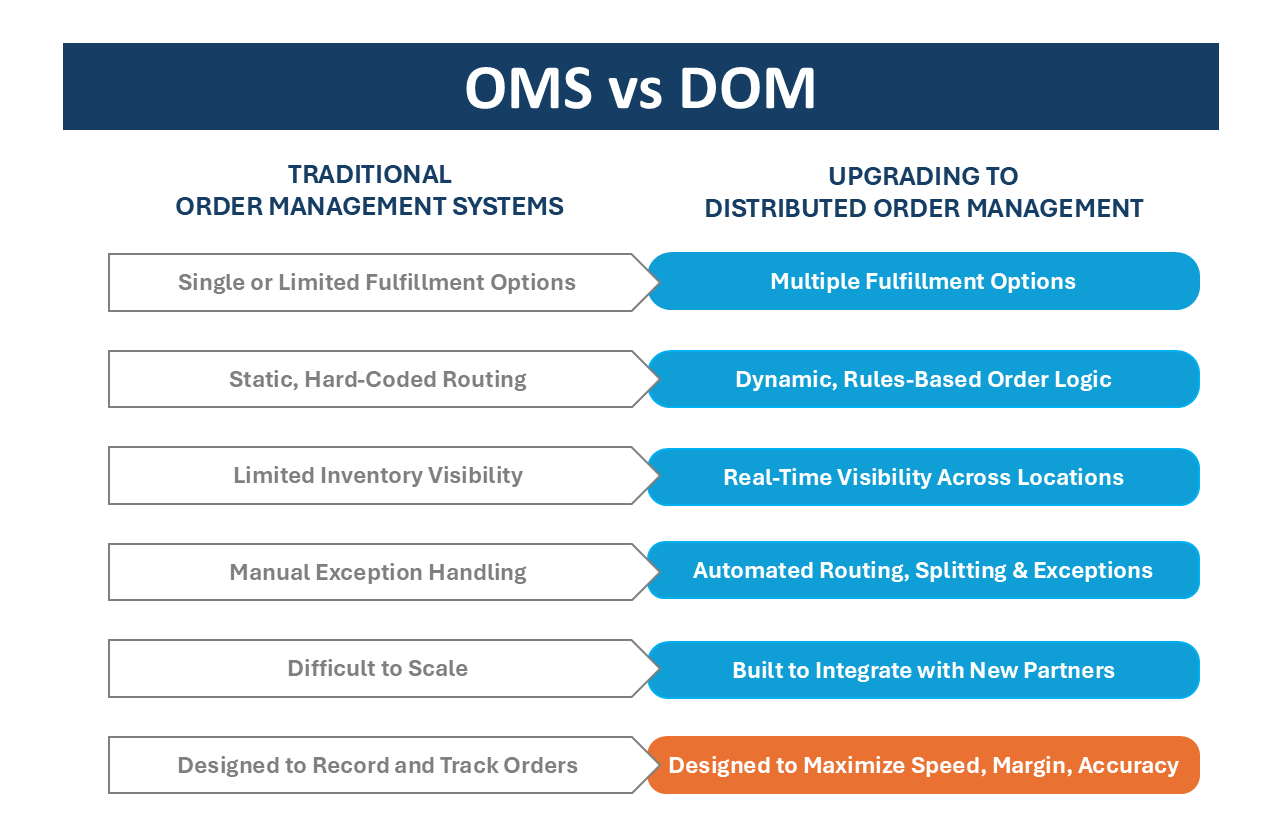
An order management system (OMS) manages basic order entry and status. Distributed order management (DOM) software adds intelligent order routing, real-time inventory visibility, and multi-node fulfillment logic across channels – which is usually designed to maximize profitability on every order.
Can DOM integrate with older ERP or WMS systems?
It depends. Some DOM platforms only work within their own ecosystems – making integrations with legacy platforms difficult and – if it’s a custom development – expensive. The Etail DOM platform is built around a powerful integration engine, designed layer over legacy infrastructure and OMS, IMS, and WMS systems that are already in place.
How does DOM help with omnichannel fulfillment?
It syncs inventory and routing rules across DTC, marketplace, wholesale, and retail channels – allowing for consistent delivery SLAs and inventory accuracy.
How does DOM improve inventory accuracy?
DOM aggregates inventory across all nodes and updates availability in real time. That helps avoid overselling, reduces safety stock, and increases inventory yield
Does DOM reduce shipping costs?
Yes. DOM evaluates all fulfillment options and selects the most cost-effective choice while still meeting delivery expectations. That reduces total delivered cost across channels.
How does distributed order management improve the customer experience?
Customers get accurate availability, faster delivery, and better communication. DOM helps ensure every order is routed in a way that meets the delivery promise.
Does DOM help with forecasting and planning?
Yes. Because DOM centralizes order and inventory data, it strengthens forecasting, replenishment decisions, and demand planning across the organization.
Is DOM only for large enterprise brands?
No. Modern DOM solutions like Etail are built for mid-market ecommerce brands that need scalable, flexible fulfillment across multiple nodes.
Additional Resources for Distributed Order Management
PLATFORM OVERVIEWS
Distributed Inventory Management
BLOG POSTS
Nine Non-Obvious Advantages of Distributed Order Management
Choosing the Best Distributed Order Management System
Distributed Logistics for Digital Commerce, Article 7: Distributed Order Management
Best Practices in Distributed Order Management
Distributed Order Management (DOM): What It Is, Why It’s Necessary, How To Get Started
Distributed Order Management Software: Best Practices and What to Consider
Maximizing Customer Satisfaction with Distributed Order Management
Optimize Fulfillment with Distributed Order Management
VIDEOS
Distributed Logistics for Digital Commerce, Part VII: Distributed Order Management