By Michael Anderson, CEO & Co-founder, Etail Solutions | Published April 9, 2026 | Last Updated: April 2026
Every D2C brand selling on Amazon eventually runs into the same math problem.
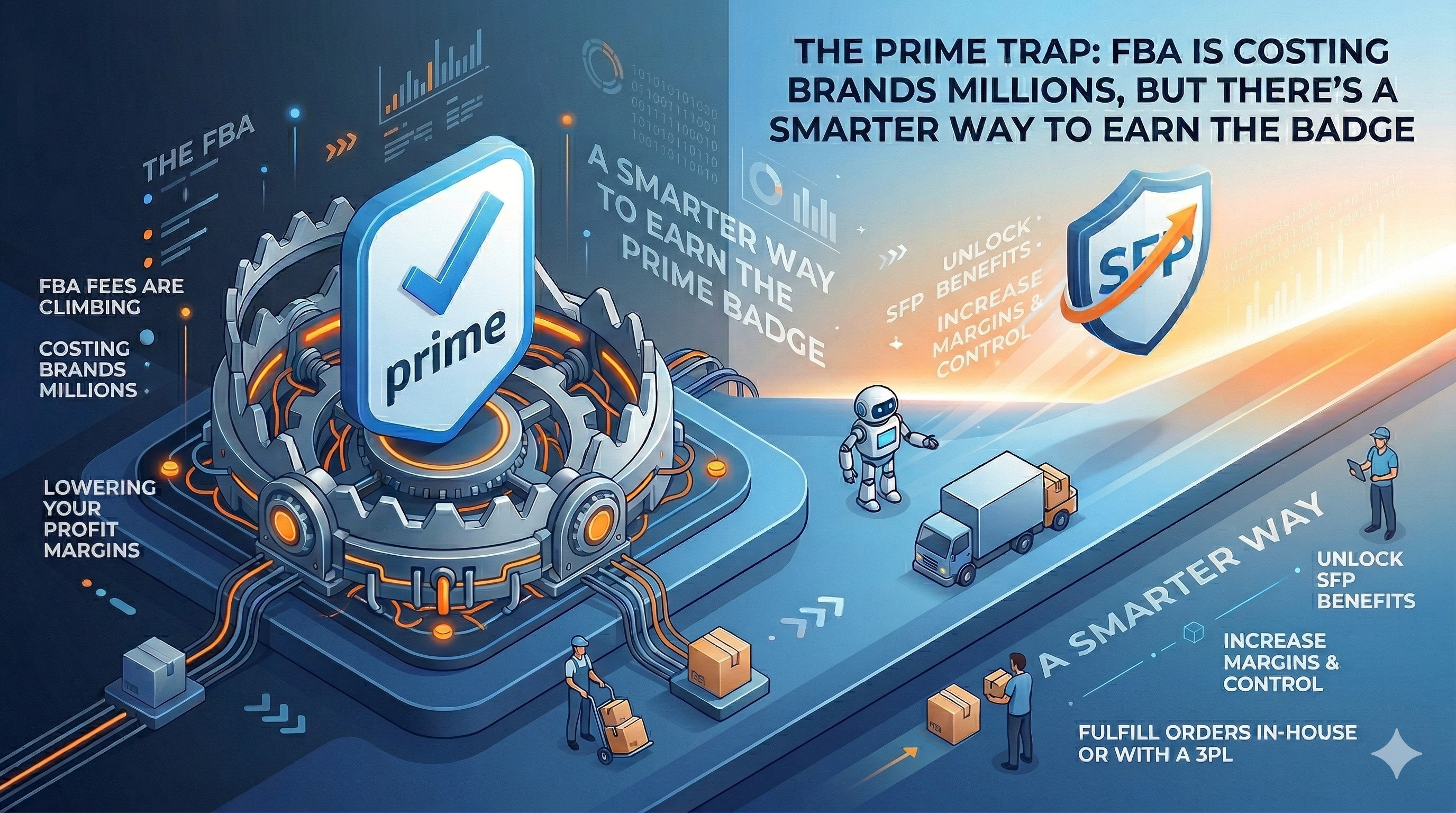
The Prime Trap is the strategic dilemma D2C brands face on Amazon: Fulfillment by Amazon (FBA) takes 30-45% of revenue in fees, but the Prime badge drives conversion rates roughly 7x higher than typical ecommerce storefronts. Seller Fulfilled Prime (SFP), combined with Distributed Inventory Management (DIM) and Distributed Order Management (DOM), offers a way to keep Prime while reclaiming margin.
Amazon takes 30-45% of your revenue before you see a dollar of profit. Referral fees eat 8-15% depending on category. FBA fulfillment fees take another 10-15% based on size and weight. Then storage fees, inbound placement fees, aged inventory surcharges, and return processing fees layer on top. For 2026, inbound defect fees alone jumped from $0.02-$0.07 to $0.32-$5.72 per unit.
For a 7- or 8-figure brand managing hundreds of SKUs, this isn't a rounding error. It's six figures in margin walking out the door every year.
So why do brands keep paying it?
One word: Prime.
The Prime Conversion Advantage Is Real
Amazon listings convert at 10-15% on average — roughly 7x what a typical Shopify store sees at 2-3%. Prime-eligible listings convert even higher. When you lose the Prime badge, you don't just lose a little icon next to your product — you lose the Buy Box advantage that drives the overwhelming majority of Amazon sales.
This is the trap. You can't afford FBA, but you can't afford to not have Prime.
Most brands treat this as a binary choice: pay Amazon's fulfillment fees and keep Prime, or fulfill yourself and watch conversion rates crater. But there's a third option that has existed for years, has gotten significantly more viable recently, and is still wildly underutilized.
What Is Seller Fulfilled Prime, and Why Do Most Brands Dismiss It?
Seller Fulfilled Prime (SFP) lets you keep the Prime badge while shipping directly from your own warehouse or 3PL network. You get the conversion advantage of Prime without handing Amazon 10-15% of your revenue in fulfillment fees.
On paper, it sounds obvious. In practice, it's been hard to pull off — and that's why most brands haven't seriously considered it.
Amazon's SFP requirements are demanding. As of mid-2025, the program requires 93.5% on-time delivery, 99% valid tracking rates, and seller-initiated cancellation rates under 0.5%. Amazon monitors these metrics weekly. Fail the same requirement twice and your Prime offers get disabled. You only get three trial attempts per year to qualify, and you can't graduate during peak season.
These aren't impossible numbers, but they're impossible to hit consistently with manual processes and a single fulfillment location. And that's exactly why most SFP attempts fail.
The brands that struggle with SFP are typically trying to meet Prime-level delivery speeds from one warehouse, using spreadsheets or basic inventory tools, with no intelligent logic deciding which location should fulfill which order.
The brands that succeed have two specific technology capabilities working in tandem.
The Two Technology Pillars That Make SFP Work
What Is Distributed Inventory Management (DIM)?
DIM is the ability to see, manage, and optimize inventory across every location in your network — your own warehouses, 3PLs, distribution partners, even Amazon's own facilities — as a single, unified pool.
This matters for SFP because Prime delivery speed is fundamentally a proximity problem. A customer in Phoenix can get two-day ground shipping from a warehouse in Las Vegas. That same order from a single warehouse in New Jersey requires air freight, which destroys your margins.
DIM solves the "where should inventory be?" question. It tells you how to distribute stock across your fulfillment network so that the maximum number of customers are within ground-shipping distance. It accounts for regional demand patterns, seasonal shifts, and SKU velocity to keep the right products in the right places.
But here's where it gets really interesting — and where most people's understanding of DIM stops short.
Owned vs. un-owned inventory. A sophisticated DIM system doesn't just track your own inventory. It understands the difference between owned and un-owned inventory. You might have 500 units of a SKU sitting in your East Coast warehouse that you own. But you might also have a distribution partner in Dallas who carries 2,000 units of that same SKU on their shelves — inventory you don't own, but that you could activate through a drop-ship relationship. DIM sees both. That distinction between owned and un-owned inventory is critical, because it dramatically expands your effective fulfillment footprint without requiring you to buy and place more inventory yourself.
Dynamic Shipping Template management. DIM also plays a protective role that most brands don't think about until it's too late. SFP eligibility for a given SKU might depend on having inventory available at four specific locations to guarantee two-day delivery coverage across the US. If one of those locations runs out of stock, you can no longer reliably meet Prime delivery speeds for every customer.
A smart DIM system detects this in real time and dynamically switches that SKU's Amazon Shipping Template. It doesn't just flip a single switch — it manages a tiered fallback. When full network coverage is available, the SKU runs on an SFP Shipping Template and earns the Prime badge. If one node loses stock but regional coverage is still strong, DIM drops the SKU to a Multi-Location Shipping Template — you lose the Prime badge, but Amazon still sees regional inventory availability, which means better placement and faster delivery estimates than a standard listing. If coverage degrades further, DIM falls back to a standard FBM Shipping Template. And when inventory is received back at the right locations, DIM detects it and promotes the SKU back up through the tiers automatically. No one has to watch a dashboard and manually swap templates.
Publishing thresholds as a last line of defense. DIM also lets you set min/max and percentage-based publishing thresholds at the SKU level. If available inventory drops below a threshold where you're not confident you can fulfill what you're promising — maybe the numbers are too low to risk an SFP commitment, or a location is nearly depleted — DIM simply publishes a zero-quantity to Amazon, effectively pulling that listing until conditions improve. When inventory replenishes and coverage is restored, DIM resets the appropriate Shipping Template and republishes availability. It's a last line of defense: even below the Shipping Template tiers, DIM won't let you sell something you can't ship.
This matters more than most people realize. Without it, you're taking SFP orders you're unlikely to fulfill within Prime delivery windows. That tanks your on-time delivery rate, which tanks your SFP metrics, which gets your Prime offers disabled. One inventory gap at one location can cascade into losing the program entirely. Dynamic Shipping Template management is the safety net that keeps your SFP status intact — and the Multi-Location fallback means even when a SKU can't qualify for Prime, you're still getting better listing performance than a standard FBM seller.
Without DIM, you're either over-stocking every location (killing your cash flow), under-stocking some (missing delivery windows and tanking your SFP metrics), or worse — taking Prime orders you can't actually fulfill on time. With it, you're placing inventory with precision, activating partner inventory you don't even own, and protecting your SFP eligibility automatically.
What Is Distributed Order Management (DOM)?
DOM is the intelligence layer that decides, in real time, which fulfillment location should handle each incoming order — and how to activate it.
When a Prime order comes in from Atlanta, a DOM system evaluates every available fulfillment node — your Dallas 3PL, your East Coast warehouse, a distribution partner in Charlotte — and routes the order to the location that can deliver on time at the lowest total delivered cost.
That phrase — "total delivered cost" — is doing a lot of work, so let me unpack it.
Full cost visibility across node types. DOM doesn't just compare shipping rates. It calculates the full cost of fulfilling an order from each possible node, and those costs look different depending on the node type. For a 3PL, DOM factors in their pick-pack-ship fees, storage charges, and outbound shipping rates. For a distribution partner fulfilling via drop-ship, DOM accounts for their product markup, handling fees, and shipping costs. For your own warehouse, it's your labor, materials, and carrier rates. Every node has a different cost profile, and DOM understands all of them.
Then it makes the call: which node can meet the delivery date at the lowest total delivered cost? And it provides a full audit trail of the decision — which nodes were evaluated, what the cost and delivery estimate was for each, why the winning node was selected, and what the alternatives were. No black box. Every routing decision is traceable and defensible.
This is what makes the 93.5% on-time delivery metric achievable at scale. Without DOM, you're routing orders based on simple rules (closest warehouse, or always the same location) that break down the moment inventory runs out or a carrier misses a pickup. With DOM, every order is an optimization problem solved in real time — with receipts.
Shipping orders vs. drop-ship purchase orders. But DOM doesn't just decide where — it decides how. Remember that DIM distinction between owned and un-owned inventory? DOM acts on it. If the optimal fulfillment node holds inventory you own, DOM sends a shipping order — pick, pack, ship. If the optimal node is a distribution partner carrying inventory you don't own, DOM sends a drop-ship purchase order instead, activating that partner's inventory through automated drop-ship workflows. The customer gets their Prime delivery. You didn't have to buy or warehouse that inventory yourself.
A distribution network, not just a warehouse network. This is where the concept of a distribution network — not just a warehouse network — becomes powerful. Your fulfillment footprint isn't limited to locations where you've placed your own stock. It extends to every vetted distribution partner whose inventory you can activate on demand. That's a fundamentally different model than FBA, where Amazon is your only fulfillment option, and it's a fundamentally different model than traditional SFP, where brands try to cover the country from two or three of their own locations.
DOM also directly impacts your shipping costs. By intelligently routing orders to minimize zone skips and dimensional weight charges, you're not just meeting Prime SLAs — you're doing it at a fraction of what FBA would cost.
How DIM and DOM Work Together: The Compound Effect
Here's what most people miss: DIM and DOM aren't just two separate tools. They create a compound effect that changes what's possible.
DIM sees all inventory — owned and un-owned — across every node, and dynamically manages which SKUs are eligible for SFP at any given moment. DOM activates the right inventory at the right location for every order, whether that means sending a shipping order to your own warehouse or a drop-ship PO to a distribution partner. Together, they create a fulfillment network that can consistently hit Prime delivery speeds — not just from your own infrastructure, but from an extended network of distribution partners whose inventory you can activate on demand.
FBA vs. Seller Fulfilled Prime with DIM + DOM: A Comparison
The SFP model isn't just cheaper. It's structurally more resilient. You're not dependent on a single fulfillment partner (Amazon) with fees that go up every year. You have a network — one that expands your reach without proportionally expanding your inventory investment.
The difference on a $10M Amazon business? Conservatively, $500K-$1M in recovered margin annually — just on the fulfillment fee delta. And that's before you factor in the reduced inventory carrying costs from activating partner inventory you don't have to purchase upfront.
This Is Just the Beginning: Why SFP Unlocks Every Channel
Here's the part that gets me genuinely excited about this model, and where I think most brands are underselling the opportunity.
If you can build a distributed fulfillment network that meets Amazon's SFP requirements — 93.5% on-time delivery, two-day speeds, automated routing across owned and partner inventory — you haven't just solved your Amazon problem. You've built infrastructure that works everywhere.
Amazon is the most demanding fulfillment standard in ecommerce. If you can hit it, you can offer that same level of speed and reliability to every other online retail partner and marketplace you sell through. Home Depot. Lowe's. Zoro. Wayfair. Target.com. Any partner that values fast, reliable delivery — which is all of them.
And here's where the competitive math gets really interesting. Online retailers increasingly want fast delivery, but in many of these relationships, the retailer is paying the shipping costs. If your fulfillment network can deliver to their customers at an average of Zone 3 shipping — because you have inventory distributed close to demand — while your competitor is shipping everything from a single warehouse at Zone 6, the cost difference is dramatic. You become a more profitable brand for the retailer to carry.
That's not a marginal advantage. That's a structural competitive edge. Retailers will prioritize brands that cost less to ship, that deliver faster, and that don't create customer service headaches from late deliveries. A distributed fulfillment network powered by DIM and DOM gives you all three.
So while SFP might be the catalyst — the thing that forces you to finally build this capability — the payoff extends far beyond Amazon. You're not just earning a Prime badge. You're building the fulfillment infrastructure that makes you the preferred brand for every channel you sell through.
The Strategic Calculus: Is SFP Right for Your Brand?
SFP isn't for everyone, and I want to be direct about that.
If you're doing 50 orders a day and shipping from a single location, FBA probably still makes sense. The operational overhead of managing a distributed network isn't worth it at that scale, and Amazon's logistics infrastructure is genuinely world-class for brands that don't yet have their own.
But if you're a mid-market or enterprise brand doing significant Amazon volume, already working with multiple 3PLs or warehouses, and watching FBA fees erode your margins year over year — SFP with the right technology stack is worth a serious look.
The questions to ask:
Do you have (or could you build) a multi-node fulfillment network? You don't need ten warehouses. Two or three strategically placed locations — your own facilities, 3PL partners, or distribution partners with drop-ship capabilities — can cover the majority of the US population within two-day ground shipping. The key insight is that not every node has to carry inventory you own.
Do you have real-time inventory visibility across owned and partner inventory? If you can't see what's available where — including inventory sitting on a distribution partner's shelves — you can't route orders intelligently or protect your SFP eligibility. This is the DIM foundation.
Can you route orders dynamically and activate different fulfillment types? SFP requires a DOM layer that doesn't just pick the closest warehouse — it needs to send shipping orders to your own locations and drop-ship purchase orders to partners, automatically, based on what each order requires.
Can you dynamically manage which SKUs are SFP-eligible? If your technology can't toggle SFP on and off at the SKU level based on real-time inventory coverage, you're one stockout away from a metric failure that costs you the program.
Are you prepared to monitor and maintain SFP metrics rigorously? Amazon doesn't give you much room for error. The technology handles most of the heavy lifting, but you need operational discipline to back it up.
The Bigger Picture: Own Your Fulfillment Destiny
The brands that will thrive over the next five years aren't the ones optimizing within a single channel's fulfillment program. They're the ones building fulfillment networks that give them options — across every channel, every retail partner, and every marketplace.
FBA is a tool, not a strategy. Using it by default because "that's how you get Prime" is leaving money on the table — potentially millions of dollars over time. But more importantly, it's leaving competitive advantage on the table. Every year you spend locked into FBA is a year you're not building the distributed fulfillment capability that would make you the preferred brand for every retailer you work with.
The technology to make this work at scale exists today. Distributed Inventory Management and Distributed Order Management aren't theoretical concepts. They're operational capabilities that brands are using right now to keep Prime conversion rates, take back control of their fulfillment economics, and turn their delivery speed into a competitive weapon across every channel they sell through.
The question isn't whether the alternative to FBA exists. It does. The question is whether you're ready to stop renting Amazon's infrastructure and start owning your fulfillment destiny.
Frequently Asked Questions
What is Seller Fulfilled Prime (SFP)?
Seller Fulfilled Prime is an Amazon program that lets sellers earn the Prime badge while shipping directly from their own warehouses, 3PLs, or distribution partners instead of using Fulfillment by Amazon (FBA). Sellers must maintain 93.5% on-time delivery, 99% valid tracking, and under 0.5% cancellation rates, monitored weekly by Amazon.
How much does FBA cost sellers?
FBA typically takes 30-45% of a seller's total revenue when you combine referral fees (8-15%), fulfillment fees (10-15%), storage fees, inbound placement fees, aged inventory surcharges, and return processing fees. For 2026, inbound defect fees increased from $0.02-$0.07 to $0.32-$5.72 per unit.
What is Distributed Order Management (DOM)?
Distributed Order Management is the technology layer that decides, in real time, which fulfillment location should handle each incoming order. DOM evaluates every available node — warehouses, 3PLs, and distribution partners — and routes each order to the location that can meet the delivery date at the lowest total delivered cost, including pick-pack-ship fees, shipping rates, and partner markups.
What is Distributed Inventory Management (DIM)?
Distributed Inventory Management is the ability to see, manage, and optimize inventory across every location in your network — including both owned inventory in your own warehouses and un-owned inventory held by distribution partners — as a single, unified pool. DIM also dynamically manages Amazon Shipping Templates by SKU based on real-time inventory coverage.
What's the difference between owned and un-owned inventory?
Owned inventory is stock you've purchased and placed in your own warehouses or 3PLs. Un-owned inventory sits on a distribution partner's shelves — you don't own it, but you can activate it through drop-ship purchase orders. A DIM system sees both types and DOM can route orders to either, dramatically expanding your fulfillment footprint without additional inventory investment.
What are Amazon Shipping Templates?
Amazon Shipping Templates define the delivery speeds and shipping options for your listings. With dynamic DIM management, a SKU can be assigned to an SFP Shipping Template (Prime badge), a Multi-Location Shipping Template (regional inventory visibility without Prime), or a standard FBM Shipping Template — and the system toggles between them automatically based on real-time inventory coverage across your network.
Can SFP work for marketplaces beyond Amazon?
Yes. The distributed fulfillment network required for SFP — with DIM providing inventory visibility and DOM providing intelligent order routing — works for any marketplace or online retail partner. If you can meet Amazon's SFP delivery standards, you can offer the same speed to Home Depot, Lowe's, Wayfair, Zoro, Target.com, and other partners, often with a Zone 3 average shipping cost that makes you more profitable for retailers to carry.

Michael Anderson is the CEO and co-founder of Etail Solutions, where he and his team build the technology that powers distributed fulfillment for D2C brands — including the Distributed Inventory Management (DIM) and Distributed Order Management (DOM) systems discussed in this article. With 25+ years in ecommerce infrastructure and ERP systems, he's helped brands connect digital demand to supply across every major marketplace and retail channel. Connect with him on LinkedIn.